
Marketing Campaign vs. Promotion: Why Founders Need More Than an Announcement
A promotion puts an offer in front of people. A campaign coordinates the strategy, customer journey, team, and follow-up needed to support a defined business goal.

Founder & CEO, Growth Gap Co
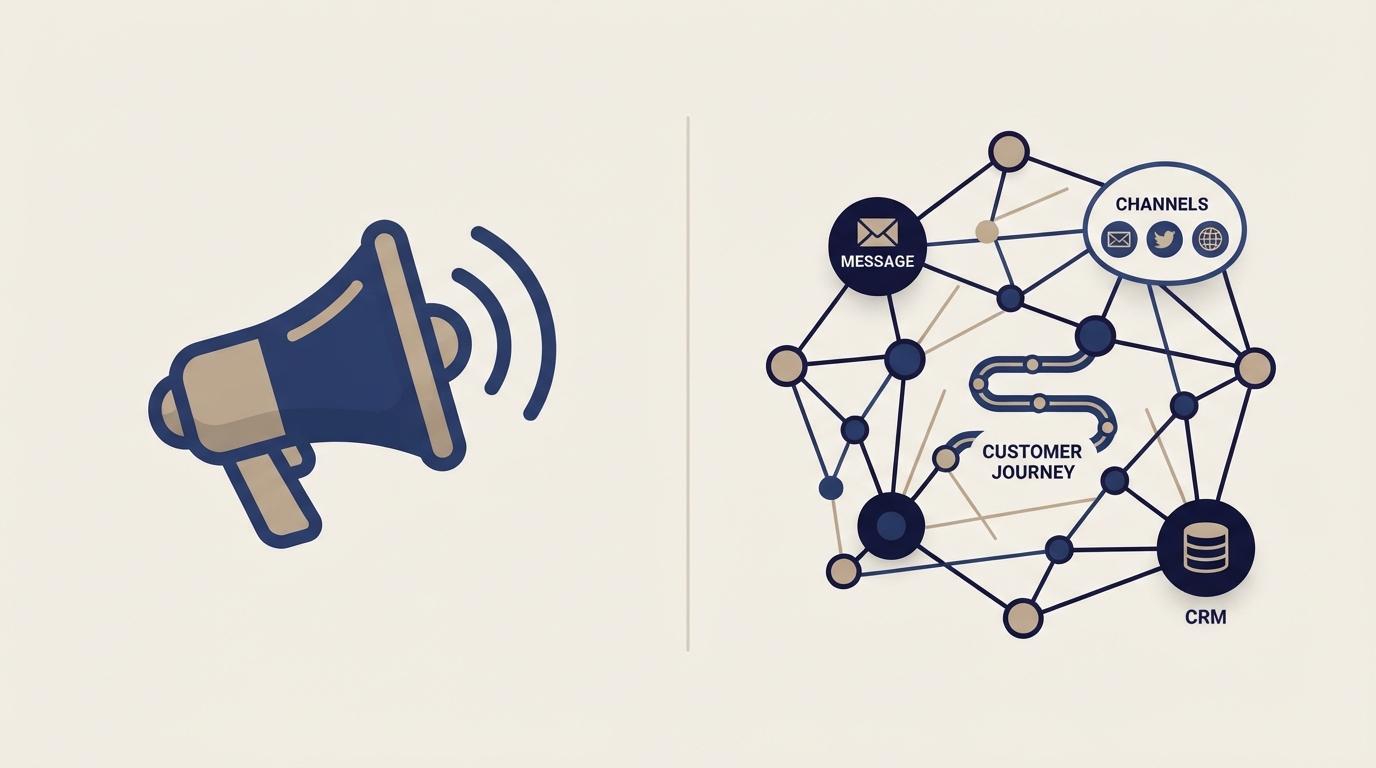
"A promotion gets the offer out. A campaign gives your team a plan to carry it through."
You have a new offer. Your team creates a graphic, writes a caption, sends an email, and publishes everything.
Then you wait.
There is some engagement. Maybe a few inquiries. But the sales you expected never arrive, and the conversation turns to whether you need more posts or a bigger discount.
Before spending more, ask a different question: Did you build a campaign, or did you announce a promotion?
Those activities can work together. But confusing them can leave your business with plenty of visibility and very little follow-through.
What is the difference between a marketing campaign and a promotion?
A marketing campaign is a coordinated set of activities designed to achieve a defined goal with a specific audience. A promotion communicates an offer or gives people a reason to take action. A promotion can be part of a campaign; the campaign connects the message, channels, customer journey, responsibilities, and measurement.
For example, an early registration offer is a promotion. The work that attracts the right people, explains the event's value, captures registrations, sends reminders, and follows up afterward forms the campaign.
One clarification matters: in marketing terminology, promotion also refers broadly to communicating an offering's value. It does not always mean a discount. The American Marketing Association includes advertising, public relations, direct marketing, and sales incentives within its discussion of promotion. Source: American Marketing Association
In this article, we are comparing a standalone promotional push with the coordinated campaign around it.
Marketing campaign vs. promotion at a glance
| Dimension | Standalone promotion | Coordinated marketing campaign |
|---|---|---|
| Main question | What are we announcing or offering? | What outcome are we working toward, and how will we get there? |
| Audience | May be sent to a broad existing audience | Defines who the message needs to reach and why |
| Messaging | Highlights an offer, benefit, announcement, or incentive | Connects the audience's problem to a relevant solution across touchpoints |
| Execution | Might be one email, post, announcement, or offer | Coordinates the activities needed to achieve the goal |
| Customer journey | Can stop at the call to action | Plans what happens before and after the response |
| Ownership | Someone publishes the promotion | People own delivery, responses, handoffs, and review |
| Measurement | Tracks responses to the promotional activity | Evaluates performance against the campaign goal |
A campaign can use one channel or several. It can run for a weekend or several months. Its defining feature is coordination around a goal, not its length, budget, or number of graphics.
Why an announcement alone can leave a growth gap
Imagine you promote a new consulting service. Someone clicks, looks at your page, and leaves because they are not ready to book.
Another person submits a form. The inquiry reaches an inbox, but nobody has clear responsibility for replying.
A third person books a call but misses it. There is no agreed process for rescheduling.
The promotion attracted attention. The next steps were incomplete.
The Growth Gap is the space between attention captured and revenue realized. At Growth Gap Co., we use that idea to examine the entire path: how people discover you, what helps them decide, and how your team handles their interest.
A stronger campaign cannot guarantee a sale. It can make the next step clearer and reduce avoidable gaps in the process.
Example: promoting a webinar vs. building a webinar campaign
The following is an illustrative example, not a client case study.
A business owner wants to host a webinar for established founders who need better marketing systems.
The promotional push
The team publishes a graphic saying, "Free webinar next Thursday. Register now." They send one invitation email and share the registration link.
That is a useful invitation. But it leaves several questions unanswered: Why should this audience care? What happens after registration? Who follows up with people who ask for help?
The coordinated campaign
The same webinar can become a campaign with a clear plan:
- 1Define the goal. Choose a target for qualified registrations and relevant follow-up conversations. These are planning targets, not promised results.
- 2Choose the audience. Focus on founders whose marketing stalls when delivery work gets busy.
- 3Build the message. Explain the problem the webinar helps them address and what they will learn.
- 4Create the registration path. Use a page with clear details, a working form, and a confirmation step.
- 5Coordinate invitations. Use relevant email segments, educational posts, and partner invitations where appropriate.
- 6Prepare the experience. Send confirmations and reminders to registrants who have agreed to receive them.
- 7Plan the follow-up. Give attendees, people who missed the event, and people who requested a conversation appropriate next steps.
- 8Review the outcome. Measure registrations, attendance, qualified conversations, and resulting sales over a suitable time period.
The invitation remains part of the work. Now it connects to an experience your team can deliver and evaluate.
What should a marketing campaign include?
For founder-led service businesses, these seven elements provide a practical starting point.
1A specific business objective
"Get more visibility" is a direction. Make it concrete enough to guide decisions. Are you introducing a service, attracting qualified consultations, reactivating previous customers, or improving renewals? Choose the outcome first. Then decide which activities support it.
2A defined audience and relevant problem
Your campaign should make it easy for the right person to recognize themselves. An established founder who needs someone to own marketing has a different problem from a new business owner learning to publish their first post. Those audiences need different messages, offers, and next steps.
3A clear offer and call to action
Tell people what they can do and why it is useful. That action could be registering for training, requesting an assessment, booking a consultation, or purchasing a service. The page they reach should deliver on the message that brought them there.
4Connected content and channels
Each piece should contribute to the campaign's goal. A post might introduce the problem. An email might explain the approach. A landing page might answer questions. A sales conversation might determine fit. Repeating a graphic across five platforms does not automatically create that connection.
5CRM and follow-up processes
Decide how inquiries will be captured, assigned, and handled. Your CRM should help your team understand where a contact came from, what they requested, and what should happen next. Use automation for appropriate confirmations, reminders, and internal tasks. Plan when messages should stop or change after a reply, booking, or purchase. Automation supports the process. People still need to handle questions and decisions.
6Clear ownership
Assign responsibility for the campaign and its critical steps. Who checks that the form works? Who responds to inquiries? Who manages the sales handoff? Who reviews performance? If every unresolved question returns to the CEO, the campaign will still depend on the CEO's daily availability.
7Measurement tied to the goal
Engagement can help explain what is happening. It does not answer every business question. For a consultation campaign, examine qualified inquiries, booked calls, attendance, opportunities, and sales. For an awareness campaign, reach among the intended audience may be a relevant primary measure. Track sources where possible, and acknowledge that referrals and multiple touchpoints can make attribution incomplete. Review results in the context of your sales cycle rather than treating every click as revenue.
Do campaigns need discounts?
No. A campaign can attract interest through relevance, education, proof, and a clear offer without reducing the price.
A launch, workshop, customer story, or service introduction can give people a reason to pay attention. A discount is one possible tactic, not a requirement.
Before offering one, consider how it affects margin, delivery capacity, and the expectations you create. A stronger reason to buy may come from explaining the value more clearly.
How Growth Gap Co. connects campaigns to revenue systems
At Growth Gap Co., our approach brings marketing leadership, execution, CRM, and automation into the same plan.
The D.A.B.A.O. Framework gives that work a structure:
Diagnose
Identify where the customer journey breaks or depends too heavily on the founder.
Align
Connect business goals, audience, offer, messaging, and team responsibilities.
Build
Put the lead capture, CRM, workflows, and handoffs in place.
Activate
Launch the campaign and manage the activities supporting it.
Optimize
Review results and improve the process.
The aim is to give your marketing team a defined direction and the systems to follow through while you lead the business.
Before your next promotion, ask these questions
- What business outcome are we trying to achieve?
- Who is this for, and why will they care?
- What happens after someone clicks, registers, replies, or buys?
- Who owns the inquiry and the next step?
- Have we tested the form, booking link, and relevant workflows?
- How will we judge the result, and when will we review it?
If those answers are missing, more promotional activity may simply send more people into an unfinished process.
A promotion gets the offer out. A campaign gives your team a plan to carry it through.
If your inquiries are slipping through the cracks, review the five CRM and automation mistakes that can cost founder-led businesses revenue.
If your business needs marketing leadership and systems that connect attention to action, explore working with Growth Gap Co. or book a Gap Scan Blueprint Session.
Frequently asked questions
Is a promotion the same as a marketing campaign?
No. A promotion communicates an offer or encourages action. A campaign coordinates activities around a defined goal. A promotion can sit within a campaign, and a well-planned promotional effort can itself be organized as a campaign.
Can one social media post be a campaign?
A post is usually a campaign asset. A small campaign can use one channel and few assets, but it still needs a goal, an intended audience, a response path, and a way to assess results.
Does a marketing campaign need paid advertising?
No. A campaign can use email, organic content, partnerships, events, or direct outreach. Choose channels based on where you can reach the intended audience and the resources available.
Why does CRM matter in a marketing campaign?
A CRM helps your team record inquiries, assign responsibility, track progress, and coordinate follow-up. It connects campaign responses to the process your business uses to serve prospective customers.
How do you measure a campaign's success?
Compare results with the goal established before launch. Use relevant measures such as qualified inquiries, attendance, sales, retention, or audience reach. Include costs and the sales cycle when interpreting performance.
What should a founder do if promotions generate interest but few sales?
Review audience fit, messaging, the offer, and the steps after the response. Check whether inquiries receive timely attention and whether prospects have a clear path forward before assuming that more posts or a lower price will solve the problem.
About the author
Joanna Sherrow is the founder of Growth Gap Co., based in Georgetown, Kentucky, USA, and the creator of the D.A.B.A.O. Framework. She helps founder-led businesses connect marketing strategy and execution with CRM, automation, and customer journey systems.
Before spending more, ask whether you built a campaign or merely announced a promotion. A campaign coordinates the message, channels, customer journey, ownership, and measurement around a defined goal.
Take the Free Gap Scan Assessment
The Growth Gap Scorecard evaluates your marketing and revenue system across 20 criteria. Find out where your momentum is leaking before you hire your next vendor.
Subscribe to Future Dispatches
Get Joanna Sherrow's newest essays on marketing architecture and revenue systems directly in your inbox.
More Dispatches & Frameworks
Fractional CMO vs. Marketing Agency Retainer: What Established Founders Actually Need
Compare a fractional CMO with a marketing agency retainer. Learn which model fits your business's needs for leadership, execution, and CRM support.
Revenue SystemsWhy Marketing Activity Fails Without a Connected Revenue System
You've hired agencies, added content, and bought new tools, yet marketing decisions still funnel directly back to you.