
How to Keep the Holiday Customers You're About to Win
According to Constant Contact's Nov 3 report, three in four shoppers plan to buy from a new small business this year, yet more than 70% of owners have no plan to invite them onto an email list or loyalty program. To keep holiday customers, ask permission at checkout, send a thank-you within a day, and schedule a January follow-up.

Founder & CEO, Growth Gap Co

75% of shoppers plan to try a new small business this season. Most of those businesses have no plan to invite them back.
That's the finding behind Constant Contact's Small Business Now Holiday Report, released Nov 3, 2026. Owners are confident: 77.2% say they're confident or extremely confident they'll hit their holiday revenue goals. The gap shows up after the sale. The growth gap here sits between a customer's first purchase and their second.
How many holiday shoppers will try a new small business this year?
Three in four. Constant Contact's Nov 3 report says 75% of shoppers are looking to buy from a new small business this year. The survey covered more than 1,800 small business owners and more than 2,600 consumers in the US, Canada, the UK, Australia and New Zealand. Every one of those first visits is a chance to earn a regular.
Why do most small businesses lose their holiday customers?
Because nobody asks them to stay. In Constant Contact's survey, more than 70% of owners don't plan to invite new holiday shoppers to their email list or loyalty program. Only 39% plan to send follow-up emails with offers in the new year, and 22% have no plan at all. The customer buys once, leaves happy, and never hears from you again.
Here's what that looks like side by side:
| Holiday sales event | Holiday list-building event | |
|---|---|---|
| Goal | Sell more in December | Sell in December and again in January |
| At checkout | Take payment | Take payment and ask permission to stay in touch |
| After the sale | Nothing | Thank-you, then a planned January offer |
| What you own in January | A good December | A list of new customers who know you |
What should I do at checkout to keep a first-time customer?
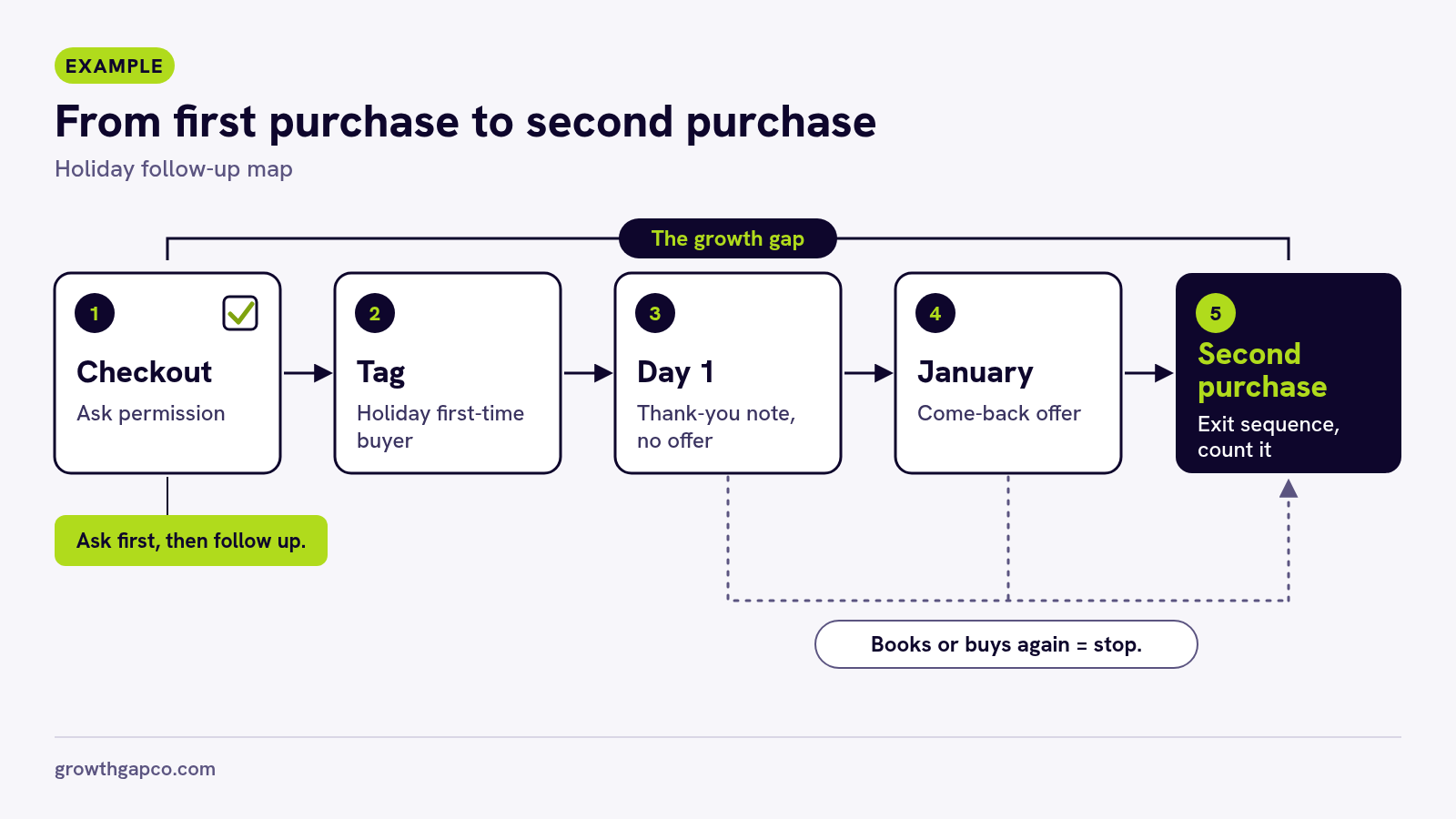
Ask one clear question: "Can we send you an occasional note with offers and reminders?" Record the answer with a checkbox or a tap on your booking or payment form, and tag the person as a holiday first-time buyer. Without clear permission, you may not be able to follow up by email or text, so this one question shapes what your January follow-up can look like. Texting usually needs its own separate, written opt-in. (This is general information, not legal advice.)
A lot of your January repeat business is decided at checkout in December.
When should I follow up with holiday customers?
Within 24 hours, then again in January. Send a short thank-you the day after the purchase, with no offer attached. Then plan a January note that gives them a reason to come back: a service that pairs with what they bought, a new-year booking window, or a returning-customer perk. Write and schedule both before the rush, while you have time to think.
Should I use AI to write my follow-up emails?
You can use it to draft them, but keep your voice in the final version. The report found more than 68% of small businesses plan to use AI to streamline operations, while planning to keep the human touch for customer service. Follow-up sits between those two. Let AI do the first draft and the scheduling. You add the detail only you know about the customer.
How do I know if my holiday follow-up worked?
Count second purchases. Before the rush, tag every first-time holiday buyer. In February, check how many booked or bought again, and from which message. In the report, 53.4% of owners say more than a quarter of their holiday customers are repeat buyers. Your own number is the one to beat next year.
What do I need to set up to keep holiday customers?
- A permission question at checkout or booking (email, and text only with a separate opt-in)
- A tag or field that marks "holiday first-time buyer"
- A day-after thank-you message, written and scheduled
- A January offer picked and written now
- A stop rule: anyone who books or buys again leaves the sequence
- One person named as owner of replies
- A February check on second purchases
What do I need to build a holiday follow-up?
- ·Access: admin login to your CRM or email tool, and to your booking or point-of-sale system
- ·Logins: the account that sends your email (your domain, set up to send)
- ·Assets: your logo, one photo, the thank-you and January copy, and your returning-customer offer
- ·Decisions: what the January offer is, who answers replies, how long a customer stays in the sequence, and whether you'll text (only with separate consent)
FAQ
Is it too late to set this up before the holidays?
No. The core pieces are a permission question, a tag, and two written messages: the thank-you and the January note. Start with the permission question at checkout, since every sale without it is a customer you may not have permission to email later.
Do I need a loyalty program?
No. A loyalty program helps some businesses, but an email list with a planned January note covers the basics. The report found more than 70% of owners don't plan to invite holiday shoppers to either one. Picking just one puts you ahead of the owners with no plan for either.
Can I just add holiday buyers to my regular newsletter?
Ask their permission first. It's the cleaner start, and a newsletter alone usually isn't enough. A first-time buyer needs a thank-you and a specific reason to come back. Send those first, then move them into your regular emails once they've bought a second time or shown interest.
What if I'm a service business, not a shop?
The same gap applies. A first-time client books a holiday service, has a good experience, and never hears from you again. Ask permission at booking, send a thank-you after the visit, and offer a January rebooking window that fits the service they had.
What is the Gap Scan?
It's a free questionnaire from Growth Gap Co. You score how your business finds, follows up with, and keeps customers, including what happens when a lead or client goes cold. Your answers show where customers slip through and which follow-up gap to look at first.
Keep the customers you're about to win
You've already done the hard part: you built a business new customers want to try. The next step is a plan to see them again in January.
Take the free Gap Scan to see where your customer journey drops people
— Joanna Sherrow, founder, Growth Gap Co.